Sunday, May 17, 2015

Astronews: A great site for developments in astronomy and stargazing, especially if you are ein Deutschsprächer

There are a lot of different sites on the web for picking up news and information about astronomy, and there are similarly a lot of new sites in German, but I really like the site Astronews for the unique combination of these two things with a genuinely fun site.
Screen capture of Astronews.com from 5/19/15

Astronews features a lot of entertaining sections, including a dynamic home page rich with images, a news feed populated with a lot of interesting content about current events and upcoming spectacles in astronomy, an "Ask Astronews" section that allows users to query the site administrators and get personalized feedback, a picture of the day section that showcases notable or praiseworthy shots daily, and a Glossary to review common or not so common astronomical terms in German.

Since I am no longer in language classes, I find it necessary to conduct a good bit of self study, so it is both pleasant and useful for me to exercise my German language skills by consuming media in German. I also genuinely like the content, since it allows me to enjoy two hobbies at once.

I would recommend Astronews to anyone looking to get quality content, whether photographical or journalistic, as well as any German language learners. If you aren't so into German, you can easily have the content translated by using Bing or Google translate.

Thursday, May 7, 2015

Summer Nights Are Great for Stargazing

I spend the winter and spring looking forward to the summer. Not only am I laden with golden sunshine during the warm days, but I have a great opportunity to go outside without excessive rain or cool temperatures and get a good look at the sky.

Friday, May 1, 2015

Nearly full moon tonight!

I'm looking forward to clear skies and a nearly full moon tonight. The astronomical full moon is coming up on May 3rd, just 2 nights away, and the lack of cloud cover makes this a great opportunity.

We are probably all familiar with the different terms used to describe the phases of the moon, waxing meaning that the illuminated portion of the moon is becoming more visible, waning means that the illuminated portion becomes less visible, crescent moon meaning that there is just a sliver of the illuminated portion visible and gibbous moon meaning that nearly all of the illuminated portion of the moon is visible.

Despite these basic definitions, and the knowledge that I have that the moon isn't full tonight, I still think of a gibbous moon as nearly full, and I'm pretty excited for a chance at getting a clear shot of the moon.

Has anyone seen a good image of the moon lately?

How are the skies in your area?

I'm unlucky enough to be unable to see the stars too frequently in my climate, due to a combination of extreme weather and excessive cloud cover making it hard to go out to a dark field and see the moon, respectively.


I'll also include a quick illustration (from stardate.org) of how the moon's appearance changes based on the position of the moon relative to the earth and the sun.


Monday, April 27, 2015

Large Field Photography

I just saw this image on Reddit, and it's fantastic.

A large field capture of the majority of the night sky, it encapsulates an uncounted number of stars, and the constellations Cassiopeia all the way to the Andromeda galaxy.

Breathtaking, but also a testament to the ability of modern recording devices, even those at the consumer level, to take very high quality wide angle shots of large fields of the night sky. The person who took this photo used a canon t3i camera with a 24 millimeter lens, then processed the image in PixInsight at ISO 1600.

I think that the image is very nice, the only critique would be that there is some artifactual light distortion likely stemming from imperfections in the glass.


You can see the image in it's full glory on the host site Imgur but a smaller version will be shared here in the post.

It's just breathtakingly large.


Friday, April 10, 2015

The MAVEN Orbiter is making it's 100th passing around Mars

Maven, an orbiting spacecraft intended to study the Martian atmosphere, is about to make its 100th journey around the red planet.

It's a landmark victory for NASA and humanity at large, as the MAVEN orbiter has been a useful tool to evaluate the changes that have taken place on Mars to the atmosphere and shed light on what may lay in wait for the planet Earth.

This is especially interesting as people discuss the possibility of going to Mars through projects like Mars One and Space X.

For more information, here's a commercial piece from ABC http://abcnews.go.com/Technology/nasas-maven-probe-learned-1000-mars-orbits/story?id=30175139

Thursday, April 2, 2015

Total Lunar Eclipse expected April 4th, 2015

Just after we've heard of the lunar eclipse visible in Northern Europe, which I mentioned earlier this year on my blog, there's word of another lunar eclipse coming up April 4th of 2015.

This will be classified astronomically as a total lunar eclipse, which means that the Earth will temporarily pass into the shadow of the moon and a portion of the world will be unable to see the Sun because of it.
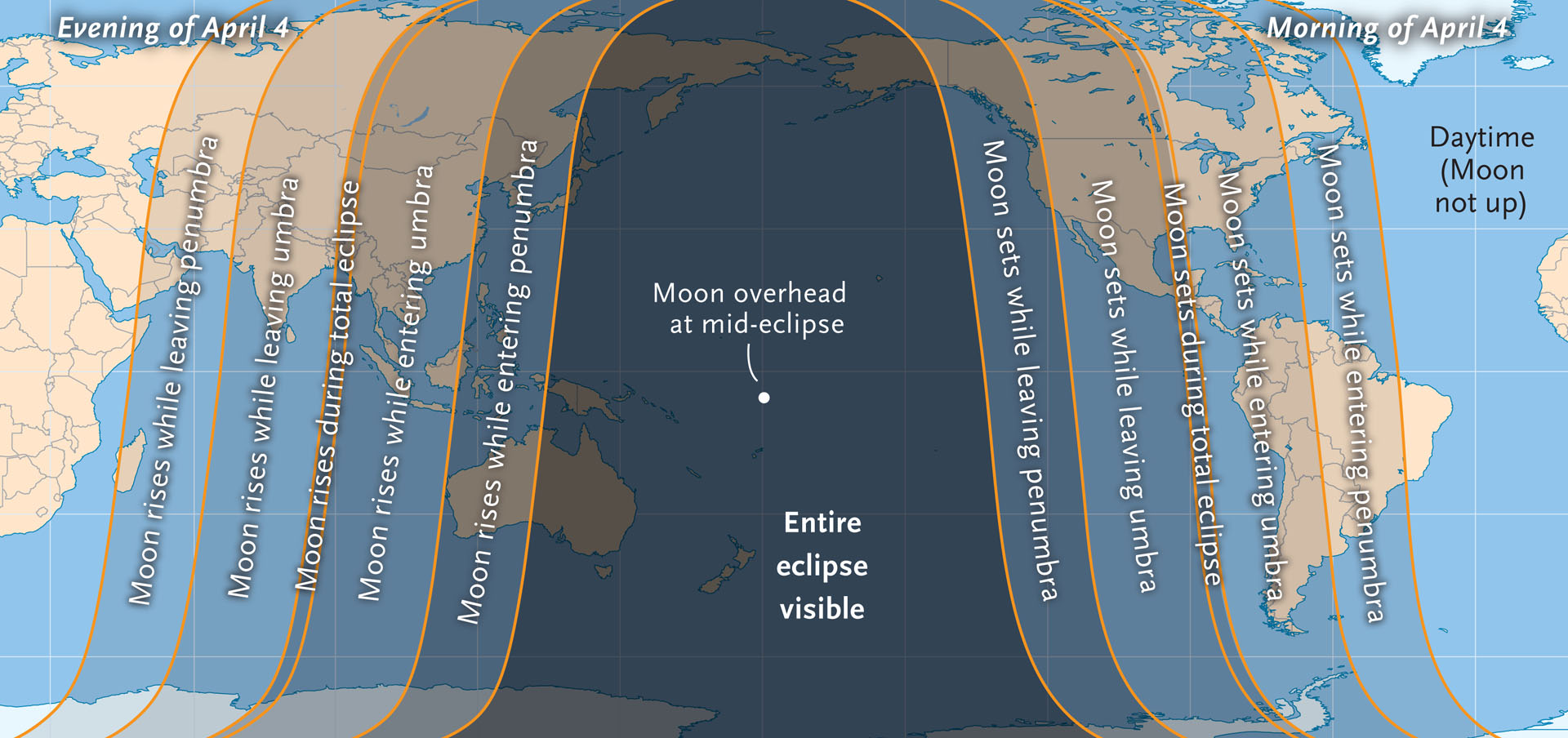
Visibility of the upcoming eclipse, sourced from Sky and Telescope
I've linked an image of the astronomical graphic, there will be complete visibility in the central Pacific, Alaska, Eastern Australia and Siberia, along with a number of island nations, and partial visibility over much of the continents of Asia, North America, and South America, where the Moon will either be "rising" or "setting" while occluding the path of the Sun's light to the Earth.

Saturday, March 21, 2015

Great Shot of the Eclipse This Week


If I have any European readers, they likely had the opportunity to witness an amazing sight over the past week, a complete solar eclipse.

These occur when the Earth moves into the shadow of the moon. As a result, our ability to see the light of the sun is reduced to elimination, and we are able to observe some really interesting results. This image shows the dark disc of the moon, and the sun's light spilling over the edges in a bright ring, which is called a corona. The best part of this shot is the way that the sun seems to peek around on the left hand side.

The photographer that posted this image referred to it as a "Diamond Ring" effect, and I am inclined to agree.

It's quite stunning.